
Broken Garage Door Spring Repair in Ocean County, NJ
A broken spring usually announces itself. You hear a loud bang from the garage, like a firecracker. Then the opener hums, and the door won’t budge.
If that just happened, leave the door where it is. Don’t try to lift it by hand. Call Paul at 732-600-1101. He answers the phone 24/7, and same-day service is available whenever possible.
Signs Your Garage Door Spring Is Broken
Not every spring breaks with a bang. Some give out quietly overnight. Look for these signs before you touch the door:
- A visible gap in the coil above the door
- A door that feels far heavier than normal
- An opener that strains, then stops after a few inches
- Cables hanging loose beside the tracks
- A door that drops fast or sits crooked in the opening
Any one of these is a reason to stop using the door. Our guide to early warning signs covers other problems worth catching.
Why Springs Fail at the Jersey Shore
Every spring has a set life. Each open and close counts as one cycle. Many standard springs are rated for about 10,000 cycles. A family that uses the garage as its front door can reach that in a few years.
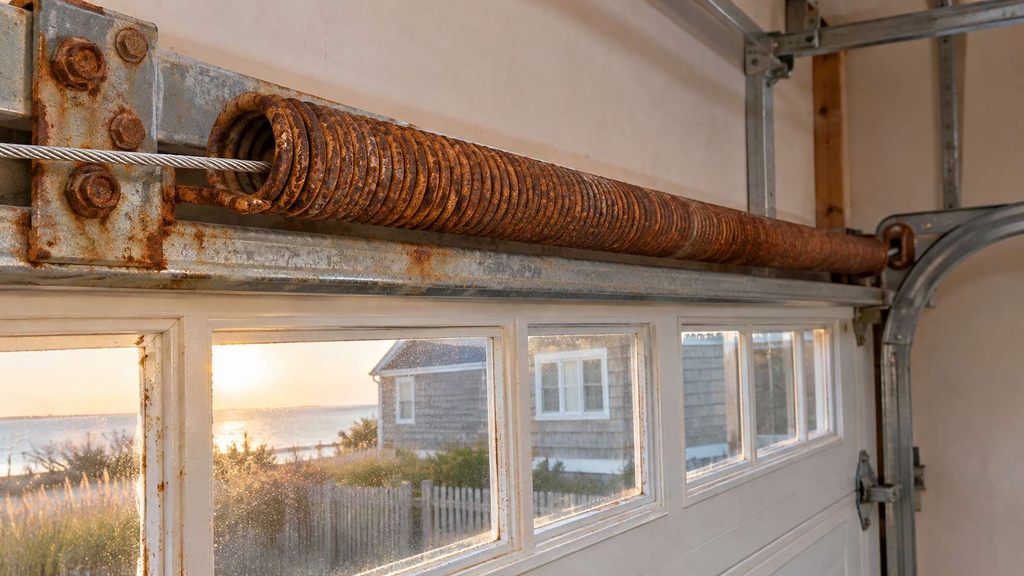
Shore weather speeds things up. Salt air rusts the coils and adds friction with every turn. Cold snaps are hard on worn steel. That is why spring failures often show up on the first cold mornings of the season.
Our post on how salt air damages your garage door shows what corrosion looks like on springs and hardware.
What to Do Right After a Spring Breaks
A few simple steps keep a bad morning from getting worse.
- Leave the door in place. A door with a broken spring can drop without warning.
- Unplug the opener so no one presses the button. The motor can strain or bend the door.
- Don’t pull the red emergency release if the door is open. It can slam shut.
- Keep kids and pets out of the garage until the repair is done.
- If your car is stuck inside, call before you try anything. Paul can talk you through it.
Spring broke after dark? Our 24-hour service page explains what happens when you call at night.
Torsion Springs vs. Extension Springs
Most garages have one of two spring setups. Knowing which one you have helps you describe the problem on the phone.
Torsion Springs
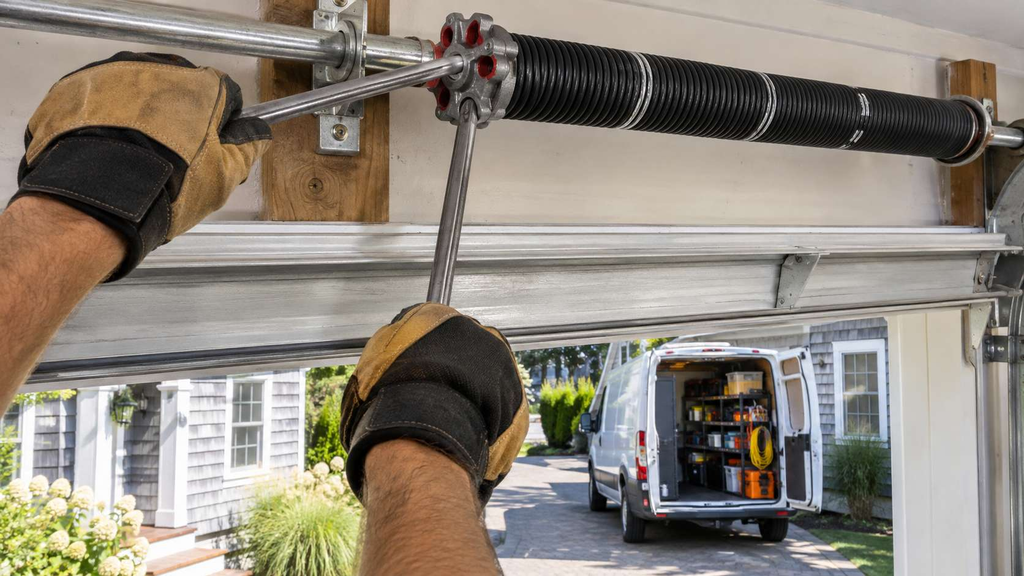
Torsion springs sit on a metal bar above the door. They wind tight as the door closes and unwind to help lift it. Most newer homes use them. A break usually leaves a clear gap in the coil.
Extension Springs
Extension springs run along the horizontal tracks on each side. They stretch as the door closes. Each one should have a safety cable running through it. Without that cable, a broken spring can whip across the garage.
How Paul Handles a Spring Repair
You deal with Paul from the first call to the final test. He owns the company, and he does the work himself. Here is what a spring visit looks like:
- Paul inspects the springs, cables, drums, rollers, and tracks.
- You get a written quote before any work starts.
- He installs new springs from his truck. Most repairs finish in one visit.
- He checks the cables and rollers and only suggests new ones if they’re worn.
- He balances the door and tests the opener’s safety reverse and photo eyes.
- He cleans up and hauls away the old parts.
Paul doesn’t cut corners or try to sell you on anything. Keeps the decisions up to me and makes sure I’m best informed, which I really appreciate.
Peter M.
Spring work is one part of our full garage door repair service. You can read more from local homeowners on our testimonials page.
Why Spring Repair Isn’t a DIY Job
Online videos make spring work look simple. It isn’t. A wound torsion spring holds enough force to break bones. Winding bars can slip. The wrong spring size throws the whole door out of balance.
Our post on why homeowners should skip the handyman covers the risks in more detail.
Repair or Replace?
A broken spring rarely means you need a new door. In most cases, new springs get the door working again. Paul will tell you if the door itself is the bigger problem.
Rusted panels, cracked sections, or a very old door may be worth replacing. If so, you’ll get both options in writing. Our garage door replacement page covers what a new door involves.
Once the door is running again, a yearly maintenance visit helps catch worn springs before they snap.
Garage Door Spring FAQs
It isn’t safe to try. The spring does the lifting, not the opener and not you. Without it, the door can weigh well over 100 pounds and drop fast. Call first, and Paul will tell you what’s safe.
On doors with two springs, both have the same number of cycles on them. When one breaks, the other is often close behind. Many homeowners replace both to avoid a second call. Paul will show you the condition of each and quote both options.
It depends on use. Many standard springs are rated for about 10,000 cycles. At three or four cycles a day, that is roughly seven to nine years. Heavy use and salt air shorten that.
Same-day service is available whenever possible. Paul answers the phone 24/7, and his truck carries replacement springs. Most spring repairs are done in one visit. For other urgent problems, see our emergency repair page.
No. Estimates on repairs are free, and you get a written quote before work begins.
Call Paul for Broken Spring Repair
Surfside Garage Doors is family-owned and based in Toms River. Paul serves homeowners across Ocean and Monmouth Counties, from Brick and Point Pleasant to Howell and Freehold. Surfside is a licensed and insured New Jersey home improvement contractor.
Off the job, Paul is a career firefighter in Newark and a volunteer with the Silverton Volunteer Fire Company. Safety is part of how he works.